When Your Tubes Was Blocjed and It Has Been Ckeard Can Ut Get Blocked Again
This blog for women having difficulty becoming pregnant explains what tubal flushing is and what research studies tell us about its effectiveness The ability of an intervention (for example a drug, surgery, or exercise) to produce a desired effect, such as reduce symptoms. and safety Refers to serious adverse effects, such as those that threaten life, require or prolong hospitalization, result in permanent disability, or cause birth defects. , and Katie shares her story of having her tubes flushed.
Page updated 22 December 2021
Take-home points
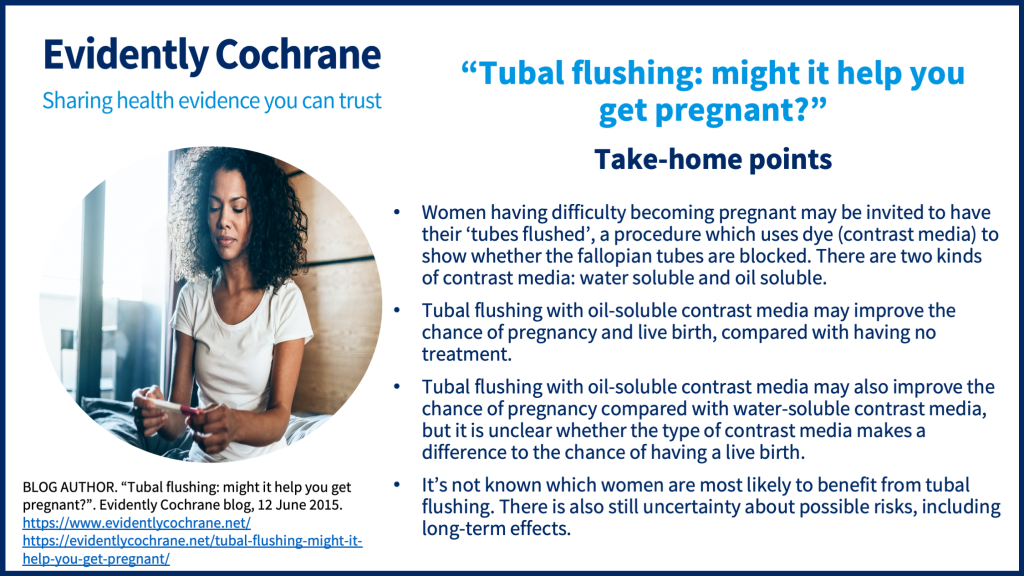
Women having difficulty become pregnant may be invited to have their 'tubes flushed', a procedure which uses dye to show whether the fallopian tubes are blocked. It has been reported that women are more likely to become pregnant after this test, but no one knows why.
A Cochrane Review Tubal flushing for subfertility has been updated (and again in October 2020) with the best available evidence on tubal flushing and its effect on pregnancy and live birth rates. We'll look at that below.
What is tubal flushing?
I asked obstetrician and gynaecologist Dr James Duffy to explain what the procedure, properly known as a hysterosalpingogram, involves:
"Hysterosalpingogram (HSG) is pronounced 'he-ster-o-sal-ping-o-gram', but fortunately most doctors call it HSG. It is a common part of a work up for women having difficulty become pregnant. Normally eggs produced by the ovaries pass down fine, narrow tubes called fallopian tubes to reach the womb. A HSG can determine if these tubes are open or blocked. If either or both of these tubes are blocked then the chances of becoming pregnant are much reduced.
Patients will lie on an x-ray table, generally flat on their back. The procedure will start in the same way as a smear examination. The doctor places a small tube called a catheter through the neck of the womb to inject dye.
Two kinds of dye are available: dyes which can be dissolved in water (water soluble) and dyes which cannot be easily dissolved in water (oil soluble). Commonly in the United Kingdom and United States doctors use a water soluble dye for HSG."
If one sort of dye is better than another, this would be helpful to know. It's also important to ask what evidence there is that tubal flushing improves pregnancy rates and live birth rates and whether this intervention A treatment, procedure or programme of health care that has the potential to change the course of events of a healthcare condition. Examples include a drug, surgery, exercise or counselling. is associated with any harms (adverse events), such as miscarriage.
The evidence for tubal flushing
This section of the blog was updated on 15 October 2020 to reflect the updated Cochrane Review on tubal flushing for subfertility. Two studies have been added and the evidence now comes from 15 randomized Randomization is the process of randomly dividing into groups the people taking part in a trial. One group (the intervention group) will be given the intervention being tested (for example a drug, surgery, or exercise) and compared with a group which does not receive the intervention (the control group). controlled trials A trial in which a group (the 'intervention group') is given a intervention being tested (for example a drug, surgery, or exercise) is compared with a group which does not receive the intervention (the 'control group'). with 3864 women. The trials Clinical trials are research studies involving people who use healthcare services. They often compare a new or different treatment with the best treatment currently available. This is to test whether the new or different treatment is safe, effective and any better than what is currently used. No matter how promising a new treatment may appear during tests in a laboratory, it must go through clinical trials before its benefits and risks can really be known. compared oil-soluble contrast media (OSCM) and water-soluble contrast media (WSCM) with each other and with no intervention.
Here's what the reviewer Somebody responsible for preparing and, in the case of Cochrane Reviews, keeping up-to-date a systematic review. The term 'reviewer' is also sometimes used to refer to an external peer reviewer, or referee. authors found:
Women having OSCM tubal flushing may be more likely to have a clinical pregnancy (confirmed by ultrasound and hormone levels) and may also be more likely to have a live birth than those having no treatment Something done with the aim of improving health or relieving suffering. For example, medicines, surgery, psychological and physical therapies, diet and exercise changes. .
It is uncertain whether WSCM tubal flushing improves the chances of becoming pregnant or having a live birth compared with no treatment.
Women having OSCM tubal flushing may be more likely to have a clinical pregnancy than those having WSCM tubal flushing. There was not enough information about how they compare in terms of live birth rates.
Possible harms of treatment, including long-term effects, were poorly reported, and it's important to know about these when making choices about treatment. OSCM was found to be probably associated with a higher risk A way of expressing the chance of an event taking place, expressed as the number of events divided by the total number of observations or people. It can be stated as 'the chance of falling were one in four' (1/4 = 25%). This measure is good no matter the incidence of events i.e. common or infrequent. of backflow of the contrast medium into the blood or lymphatic vessels, which mostly causes no symptoms.

How good is the evidence?'
Whilst this is the best we have, there were problems with the studies and the evidence is mostly 'very low- or low-certainty', so the reviewers were not able to draw conclusions with confidence. What we have so far suggests that tubal flushing with oil-soluble contrast media may improve the chance of pregnancy and live birth, compared with doing nothing, but we can't be at all sure. Only seven of the 15 studies reported live birth rates, although this is a crucial measure of the success of fertility treatments. We don't know which women are most likely to benefit. We also remain uncertain about possible risks of this procedure and these need to be fully evaluated in future research.
Katie's story
"In 2007 my husband I decided that after several years of trying for a baby, we needed some help. Our lives were on hold as we lived month-to-month hoping to be pregnant and then facing the disappointment that we weren't.
After a referral from the doctor, our consultant took it all seriously, made us feel important and referred me on to have a laparoscopy with an HSG, where my tubes would be flushed with liquid to identify any blocks. I bought new pajamas for my day in hospital. This was my first general anesthetic. As I came round, fuzzy and woozy, the doctor came to share the results with my husband and me. I was not awake enough to take it all in. He talked about one tube being blocked. We were told we'd have another appointment with the consultant to talk about what next.
As we packed up to go, a nurse came by to discharge me. She said, "It happens all the time that women get pregnant after getting their tubes flushed. I hope you'll be pregnant soon." This was not presented as fact, but an aside based on her years of experience. I took it that she was trying to give some solace after an uncomfortable procedure, not based on any evidence.
The next month, I was pregnant and now I am a mother of two. When we went in for that procedure we had no idea it might be the catalyst that would change everything. It was never presented as an intervention that might help me get pregnant; the focus was on the process and uncovering problems. I think it would be useful for women considering having their tubes flushed to consider that it could help them get pregnant, that it is a procedure that can lead to a happy outcome Outcomes are measures of health (for example quality of life, pain, blood sugar levels) that can be used to assess the effectiveness and safety of a treatment or other intervention (for example a drug, surgery, or exercise). In research, the outcomes considered most important are 'primary outcomes' and those considered less important are 'secondary outcomes'. , a much-desired pregnancy. This would be welcome milestone for a woman who, like me, had been struggling for years with concerns about infertility.
The research states tubal flushing may improve the chance of getting pregnant. In my case, it did result in pregnancy and the birth of my baby. I'd welcome more research into this area, so women could head into a tubal flushing procedure with some confidence that it may help them fall pregnant and with less risk of multiple pregnancy than some of the other options."
Join in the conversation on Twitter with @CochraneUK or leave a comment on the blog. Please note, we will not publish comments that link to commercial sites or appear to endorse commercial products. We welcome diverse views and encourage discussion but ask that comments are respectful and reserve the right to not publish comments we consider offensive.
Read more about fertility and women's health.
Other posts
- Endometrial scratching: what's the latest evidence?
- Timed intercourse: will it help you conceive?
Please note, we cannot give specific medical advice and do not publish comments that link to individual pages requesting donations or to commercial sites, or appear to endorse commercial products. We welcome diverse views and encourage discussion but we ask that comments are respectful and reserve the right to not publish any we consider offensive. Cochrane UK does not fact check – or endorse – readers' comments, including any treatments mentioned.
Links:
Wang R, Watson A, Johnson N, Cheung K, Fitzgerald C, Mol BWJ, Mohiyiddeen L. Tubal flushing for subfertility. Cochrane Database of Systematic Reviews In systematic reviews we search for and summarize studies that answer a specific research question (e.g. is paracetamol effective and safe for treating back pain?). The studies are identified, assessed, and summarized by using a systematic and predefined approach. They inform recommendations for healthcare and research. 2020, Issue 10. Art. No.: CD003718. DOI: 10.1002/14651858.CD003718.pub5.
Source: https://evidentlycochrane.net/tubal-flushing-might-it-help-you-get-pregnant/
0 Response to "When Your Tubes Was Blocjed and It Has Been Ckeard Can Ut Get Blocked Again"
Post a Comment